
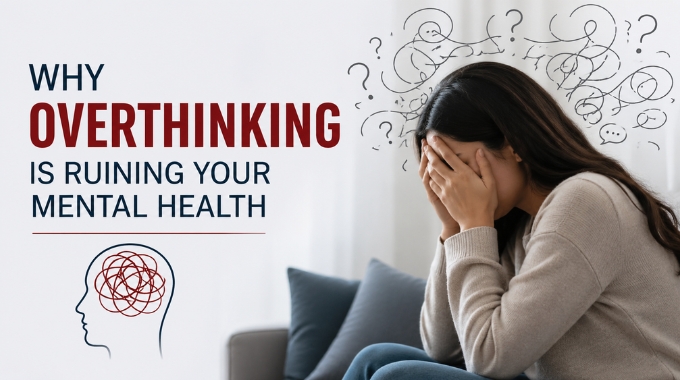
Overthinking harms your mental health by increasing anxiety, disrupting sleep, lowering confidence, and keeping your mind stuck in a constant loop of stress. If not managed, it can lead to long-term issues like chronic anxiety or depression.
Here’s what overthinking does to your mind:
- Keeps your brain in a constant stress mode
- Drains your energy and focus
- Creates self-doubt and fear
- Makes decision-making harder
If your mind keeps replaying conversations, imagining worst-case scenarios, or questioning every decision—you’re not alone.
What feels like “thinking things through” is often mental overload that quietly damages your peace of mind.
The truth is: overthinking doesn’t solve problems—it creates them.
In this guide, you’ll learn why overthinking happens, how it affects your mental health, and how to stop it before it takes control of your life.
What Is Overthinking and Why It’s So Hard to Stop
Overthinking is a mental pattern where your brain repeatedly analyzes thoughts, situations, or possibilities—often without reaching any solution.
It usually appears in two forms:
- Rumination (past-focused): replaying past mistakes or conversations
- Worry (future-focused): imagining negative outcomes or worst-case scenarios
Your brain believes it’s protecting you—but in reality, it keeps you trapped in stress.
Studies in psychology show that repetitive negative thinking is strongly linked to anxiety and depression, making overthinking more than just a habit—it’s a mental health risk.
Signs You’re Overthinking More Than You Realize
You may not notice it immediately, but these signs indicate your thoughts are becoming overwhelming:
- You replay conversations repeatedly
- You struggle to make decisions
- You imagine worst-case outcomes frequently
- You feel mentally exhausted without doing much
- You have trouble sleeping because your mind won’t stop
- You constantly doubt yourself
If this sounds familiar, your mind isn’t being productive—it’s overloaded.
If these patterns feel difficult to control, professional support can help you regain clarity and balance.
How Overthinking Is Ruining Your Mental Health
Overthinking doesn’t just affect your thoughts—it impacts your entire emotional and physical well-being.
It increases anxiety
Constantly focusing on what could go wrong keeps your brain in a state of fear and alertness.
It leads to depression
Over time, repeated negative thinking can lower mood, motivation, and hope.
It disrupts sleep
Your mind stays active at night, preventing proper rest and recovery.
It drains your energy
Mental overload leads to fatigue, even without physical effort.
It causes decision paralysis
Too much thinking makes even simple choices feel overwhelming.
It affects relationships
Overanalyzing situations can create misunderstandings and unnecessary stress.
What feels like control is actually mental exhaustion in disguise.
Many people who overthink also experience a sense of emptiness or lack of emotions. This isn’t uncommon and often has deeper psychological causes.
Learn more about it here:Why Do I Feel Empty for No Reason?
Why Do People Overthink
Overthinking is often driven by deeper emotional patterns:
- Fear of failure
- Need for control
- Low self-confidence
- Past experiences or trauma
- High stress levels
It’s important to understand this:
Overthinking is not who you are—it’s a habit your brain has learned.
And habits can be changed.
The Overthinking Loop (Why It Feels Impossible to Stop)
Overthinking follows a repeating cycle:
- A thought appears
- You analyze it deeply
- You feel anxious
- You try to fix it by thinking more
- Anxiety increases
The more you think, the worse you feel—and the harder it becomes to stop.
Can You Stop Overthinking on Your Own?
In mild cases, yes—you can manage overthinking with awareness and simple techniques.
But when:
- Thoughts feel uncontrollable
- Anxiety is constant
- Sleep is affected
- It impacts daily life
Self-help may not be enough.
This is when professional support becomes important to break the cycle effectively.
How to Stop Overthinking (Practical Strategies That Work)
You don’t need to stop thinking—you need to manage it.
- Set a time limit: Give yourself a fixed time to think, then move forward
- Practice mindfulness: Focus on the present moment to break thought loops
- Write your thoughts down: Helps clear mental clutter
- Take action: Even small steps reduce uncertainty
- Challenge your thoughts: Ask if they are realistic or based on fear
These techniques can reduce overthinking—but consistency is key.
When Overthinking Becomes a Serious Problem
Occasional overthinking is normal, but it becomes a concern when:
- It interferes with your daily life
- You feel constant anxiety or stress
- You cannot control your thoughts
- It affects your sleep or mood
If ignored, overthinking can slowly develop into more serious mental health conditions.
Early intervention can prevent long-term impact.
How Professional Help Can Break the Cycle
If overthinking feels overwhelming, therapy can help you:
- Identify negative thought patterns
- Learn effective coping strategies
- Reduce anxiety and stress
- Improve clarity and decision-making
Evidence-based treatments like Cognitive Behavioral Therapy (CBT) are highly effective in managing overthinking and anxiety.
You don’t have to manage this alone.
What to Expect in Your First Session
If you’re unsure about seeking help, here’s what typically happens:
- You discuss your thoughts and experiences
- A professional understands your patterns
- A personalized plan is created
It’s a safe, confidential, and judgment-free space designed to help you feel better.
Why Choose Behavioral Healthcare, P.C.
When overthinking starts affecting your life, the right support matters.
Behavioral Healthcare provides:
- Over 30 years of experience
- Board-certified psychiatrists
- Personalized treatment plans
- Evidence-based therapies
- Compassionate, patient-focused care
Is It Worth Getting Help
Many people delay seeking help, thinking they can manage on their own.
But untreated overthinking can lead to:
- Chronic anxiety
- Depression
- Emotional burnout
Taking action early can improve your quality of life, relationships, and mental clarity.
Frequently Asked Questions
Why do I overthink everything?
It’s usually caused by anxiety, fear, or a need for control.
Is overthinking a mental illness?
No, but it’s linked to anxiety and depression.
How can I stop overthinking quickly?
Focus on the present, limit thinking time, and take action.
Can overthinking affect my physical health?
Yes, it can cause stress, fatigue, and poor sleep.
When should I seek professional help for overthinking?
If it affects your daily life or sleep, seek help.