
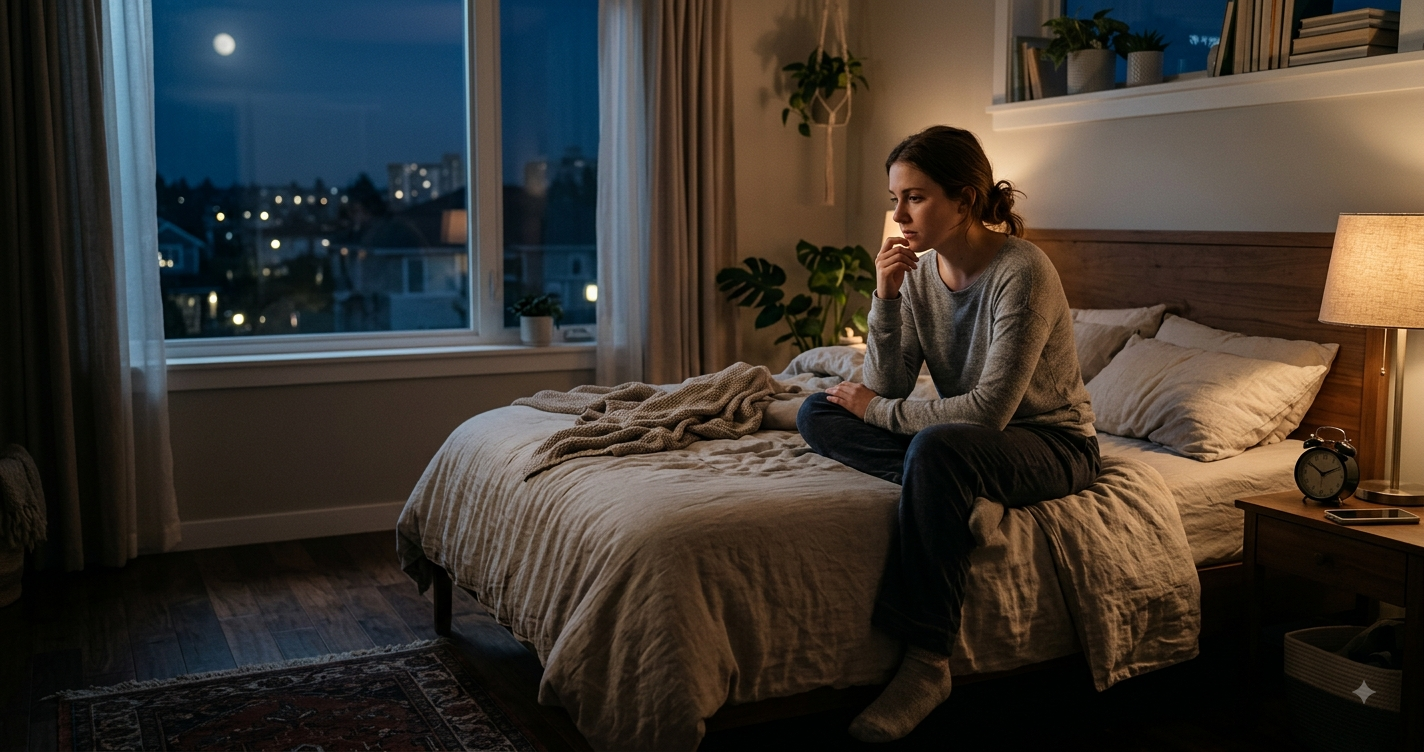
Why Does My Anxiety Get Worse at Night? The Short Answer
Anxiety tends to spike at night because of a combination of biology and timing: your cortisol rhythm shifts, your brain loses the daytime distractions that were quietly competing with your worries, and your body’s threat-detection system becomes more sensitive without other input to occupy it. One large study tracking more than 49,000 people found that mood, happiness, and life satisfaction tend to peak in the morning, while anxiety and depressive symptoms are typically at their lowest earlier in the day and climb as evening approaches.
None of this means something is wrong with you specifically. It means nighttime is genuinely a more vulnerable window for anxiety, for almost everyone who deals with it.
The Cortisol Pattern Behind Nighttime Anxiety
Your body runs on a roughly 24-hour internal clock called your circadian rhythm, and it directly controls your cortisol levels throughout the day. Normally, cortisol peaks in the early morning to help you feel alert, then gradually declines as the day goes on, dropping to its lowest point by bedtime so melatonin can rise and help you wind down.
In people dealing with anxiety, this pattern often doesn’t behave the way it’s supposed to. Cortisol can stay elevated into the evening instead of tapering off, keeping your body in a state that feels more like “stay alert” than “time to relax.” That mismatch, your body chemically primed for alertness right when you’re trying to sleep, is a big part of why anxiety at night can feel so physically uncomfortable, not just mentally loud.
Why Silence and Stillness Make It Worse
During the day, your brain has a lot competing for its attention: conversations, tasks, screens, movement. All of that quietly occupies mental bandwidth that might otherwise go straight to worry. At night, once the distractions disappear, your mind finally has room to focus inward, and it often lands directly on whatever you didn’t fully process during the day.
Research has specifically pointed to this reduced cognitive load in the evening as a reason intrusive thoughts become more noticeable once things quiet down. It’s not that new worries appear out of nowhere. It’s that the ones you’d been outrunning all day finally catch up once there’s nothing left to outrun them with.
Why Your Brain Picks Nighttime Specifically
Without competing sensory input, your brain’s threat-detection system has less to filter through, so it becomes more sensitive rather than less. In a quiet, dark room, that system doesn’t have much else to react to, so it tends to lock onto whatever internal worry is available instead.
The Role of Sleep Itself
Anxiety and sleep have a frustrating two-way relationship. Anxiety makes it harder to fall and stay asleep, since your body remains in a state of alertness rather than settling into the calm needed for deep sleep. But poor sleep also feeds anxiety right back, disrupted rest impairs your ability to regulate emotions the next day, which can make anxious thoughts feel even more intense the following night. Left unaddressed, this can turn into a cycle where each night makes the next one a little harder.
Other Everyday Factors That Pile On
A few common, very fixable factors tend to make nighttime anxiety worse without people realizing it:
- Caffeine, especially in the afternoon. It stays in your system longer than most people expect and can interfere with both sleep and cortisol regulation.
- Screen time right before bed. Blue light exposure can suppress melatonin production, working against your body’s natural wind-down process.
- Irregular sleep schedules. Inconsistent bedtimes make it harder for your circadian rhythm to stay on track, which can worsen the exact cortisol mismatch driving nighttime anxiety.
- Unprocessed stress from earlier in the day. If it never got addressed during daylight hours, nighttime is often where it resurfaces.
Why This Isn’t Just “Overthinking”
I want to push back gently on a phrase I hear a lot: “I just overthink at night.” That framing makes it sound like a personal habit you should be able to switch off through sheer willpower. What’s actually happening is more physiological than that, a real hormonal mismatch combined with a nervous system that’s more reactive without daytime distraction. Understanding it this way tends to reduce the shame that often piles on top of the anxiety itself.
What Actually Helps at Night
- Build a consistent wind-down routine. Doing the same calming activities each night, reading, a warm shower, gentle stretching, helps signal to your circadian rhythm that it’s time to shift out of alert mode.
- Address worries earlier in the day, on purpose. Setting aside 10-15 minutes to actually think through what’s bothering you, sometimes called worry time, can reduce how much resurfaces at night.
- Limit caffeine after early afternoon and reduce screens before bed. Both directly interfere with the hormonal shift your body needs to relax.
- Consider Cognitive Behavioral Therapy for insomnia (CBT-I) or general anxiety treatment if this has become a consistent pattern. Our CBT program addresses the thought patterns fueling nighttime anxiety directly, rather than just managing symptoms in the moment.
Common Mistakes People Make
- Lying in bed trying to “push through” racing thoughts. This often reinforces the association between your bed and anxious alertness rather than calm.
- Using screens to distract from anxiety before sleep. This tends to worsen the underlying hormonal mismatch rather than resolve it.
- Ignoring caffeine timing. Even afternoon caffeine can meaningfully affect nighttime anxiety and sleep quality.
- Assuming nothing can be done about it. Nighttime anxiety is a well-understood, treatable pattern, not something you’re simply stuck with.
Frequently Asked Questions
- Why does my anxiety get worse at night specifically? A combination of shifting cortisol patterns, reduced daytime distractions, and a more sensitive threat-detection system in quiet, dark environments all contribute to anxiety intensifying at night.
- Is it normal for anxiety to be worse at night than during the day? Yes. Research shows anxiety and depressive symptoms commonly peak later in the day for a large portion of people, not just those with a diagnosed anxiety disorder.
- Can poor sleep actually cause anxiety, or does anxiety just cause poor sleep? Both directions are real. Anxiety disrupts sleep, and poor sleep worsens the brain’s ability to regulate emotions the next day, creating a cycle that can compound over time.
- Does caffeine really affect nighttime anxiety even if I only drink it in the morning? Afternoon caffeine is more likely to be the issue, since it stays in your system for hours and can interfere with the natural evening decline in cortisol.
- What is nighttime anxiety a symptom of? It can occur on its own or as part of a broader anxiety disorder. Persistent nighttime anxiety is worth mentioning to a professional, especially if it’s affecting your sleep or daily functioning.
- Can therapy actually help with anxiety that’s specifically worse at night? Yes. Cognitive Behavioral Therapy, including CBT specifically adapted for insomnia, has real evidence behind it for reducing nighttime anxiety and improving sleep quality.
- Should I see a doctor if my anxiety is only bad at night? If it’s persistent, affecting your sleep regularly, or interfering with how you function the next day, it’s worth a professional evaluation, even if it feels manageable during daylight hours.
Final Thoughts
Why does my anxiety get worse at night? Because your biology genuinely sets you up for it, shifting cortisol patterns, fewer distractions, and a more sensitive nervous system all converge right when you’re trying to wind down. This isn’t a personal failing or something you should be able to think your way out of through willpower alone. It’s a well-understood pattern, and it responds well to the right combination of habits and, when needed, professional treatment.
Tired of Anxious Nights?
If nighttime anxiety has been a consistent pattern, reach out to schedule an evaluation with our Michigan team. We’ll help you understand what’s driving it and build a plan to actually get your evenings back.