
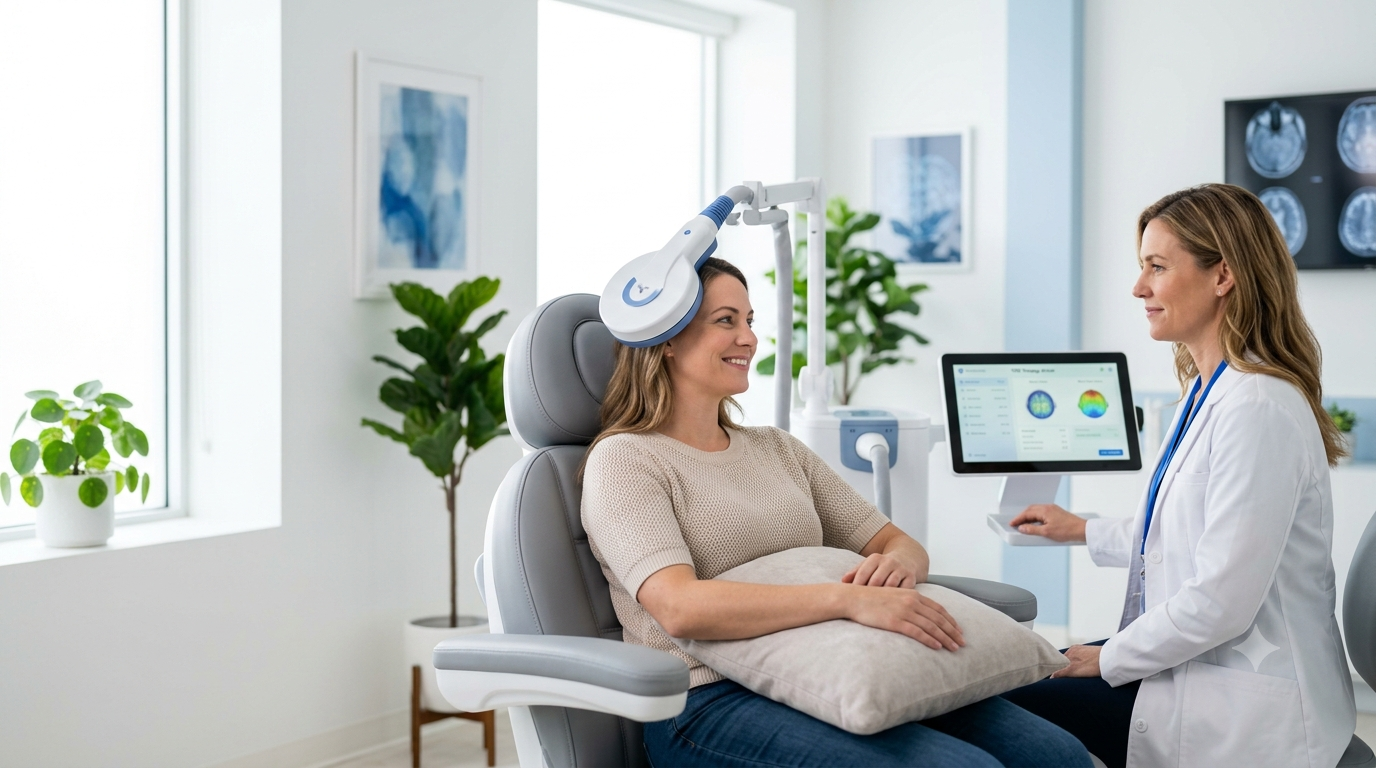
For patients who’ve tried standard antidepressants without enough relief, TMS is generally worth considering — clinical trial data shows response rates between 50% and 67%, with remission rates between 30% and 37%, making it one of the more evidence-backed next steps available. It isn’t a first-line treatment, and it isn’t for everyone, but for people who feel like they’ve run out of options, the data supports it more often than not.
“I’ve tried three different antidepressants. Nothing’s worked. Is there anything left?” I hear a version of this question often, usually from patients who’ve done everything right and are still stuck. For a lot of them, the answer ends up being TMS, and the follow-up question is always the same: does it actually work, or is this just the next thing to try?
What We’ll Cover
- What TMS Actually Is (In Plain Terms)
- So, What Are the Real Success Rates?
- Who Tends to Benefit Most From TMS?
- What a TMS Session Actually Feels Like
- Is It Safe? What the Side Effect Data Shows
- TMS vs. Medication vs. ECT: How Do They Compare?
- Is TMS Worth It for You? A Few Honest Questions
- Mistakes Patients Make When Considering TMS
- Frequently Asked Questions
- My Take, After Years of Prescribing It
What TMS Actually Is (In Plain Terms)
Transcranial Magnetic Stimulation uses focused magnetic pulses to stimulate the areas of the brain involved in mood regulation, specifically the prefrontal cortex, an area that tends to be underactive in depression. It’s non-invasive, doesn’t require anesthesia, and patients are awake and alert the entire time.
The FDA first cleared TMS for treatment-resistant depression back in 2008. Since then, it’s also received clearance for OCD, and more recently, for adolescent depression as well. If OCD is part of what you’re navigating, our OCD treatment program covers how TMS fits into that picture specifically.
So, What Are the Real Success Rates?
Here’s where I want to be precise, because “success rate” gets thrown around loosely online. In the research that led to FDA clearance, response rates for TMS in treatment-resistant depression have generally landed somewhere between 50% and 67%, with remission rates, meaning symptoms nearly or fully resolve, typically in the 30% to 37% range. Some open-label, real-world studies have reported response rates as high as 70% to 80%, particularly with newer accelerated protocols.
To put that in context: after two failed medication trials, the odds of a third medication working drop significantly. TMS doesn’t have that same ceiling, which is exactly why it’s typically offered to patients after standard treatments haven’t provided enough relief, not instead of them.
Why “Treatment-Resistant” Doesn’t Mean “Untreatable”
I want to push back gently on how discouraging that label sounds. Treatment-resistant simply means standard first and second-line options haven’t worked yet. It doesn’t mean nothing will. In my experience, this is exactly the population where TMS tends to make the biggest difference.
Who Tends to Benefit Most From TMS?
TMS isn’t the right starting point for everyone, and I don’t recommend it as a first-line treatment. It tends to be most appropriate for patients who:
- Have tried at least one, often two, antidepressant medications without adequate relief
- Want an option without the systemic side effects that come with medication
- Are dealing with OCD or depression specifically, since that’s where the strongest evidence exists
- Don’t have contraindications like certain metallic implants or a seizure history
Not everyone is a candidate, and a proper screening matters more than people expect. Our guide on who should avoid TMS treatment covers this in detail, and it’s exactly the kind of thing we walk through before starting anyone on a course of treatment.
What a TMS Session Actually Feels Like
A standard course typically runs about 36 sessions, delivered five days a week over roughly six weeks, though newer accelerated protocols can compress this significantly. Each session lasts 20 to 30 minutes. You’ll feel a tapping or clicking sensation on your scalp, sit in a chair the whole time, and drive yourself home immediately after. No downtime, no sedation, no recovery period.
Most patients describe the first session or two as the strangest part, simply because the sensation is unfamiliar. After that, it becomes routine fairly quickly.
Is It Safe? What the Side Effect Data Shows
TMS has a strong safety profile compared to many other treatment-resistant depression options. The most common side effects are mild: scalp discomfort, headache, and occasionally minor sleep changes, most of which ease within the first week or two of treatment.
Seizure risk exists but is rare, generally cited at well under 1% in properly screened patients. This is exactly why pre-treatment screening, including neurological history, matters so much before anyone starts.
TMS vs. Medication vs. ECT: How Do They Compare?
Medication remains the right first step for most patients, and I’m not suggesting otherwise. But antidepressants come with systemic side effects, and a meaningful number of patients don’t get full relief even after multiple trials.
Electroconvulsive Therapy (ECT) is generally more effective for the most severe, treatment-resistant cases, but it requires anesthesia and carries a higher side-effect burden, including short-term memory effects. TMS sits in between: less invasive than ECT, and often effective where medication alone hasn’t been enough. It’s not a replacement for either. It’s another tool, and which one makes sense depends entirely on your specific history.
Read this for more info: TMS Therapy vs Antidepressants: Which One Works Better?
Is TMS Worth It for You? A Few Honest Questions
- Have you given at least one antidepressant a genuine trial, at an adequate dose, for long enough to know if it worked?
- Are the side effects of medication a bigger burden than the condition itself?
- Do you have any contraindications, like certain implants or a seizure history, that a provider would need to screen for?
- Are you able to commit to a multi-week course of daily sessions?
If most of your answers point toward “yes, and I’m still stuck,” that’s usually the point where TMS becomes a genuinely reasonable next step, worth discussing with a psychiatrist directly.
Mistakes Patients Make When Considering TMS
- Expecting it to work faster than it does. Most patients notice change gradually, often building over the first several weeks, not the first session.
- Skipping proper screening. Contraindications matter, and a rushed intake increases risk unnecessarily.
- Treating it as a total replacement for therapy. TMS and therapy work well together, not as competing options.
- Giving up too early in the course. Response often builds cumulatively across sessions rather than showing up immediately.
Frequently Asked Questions
- What is the actual success rate of TMS therapy? Response rates generally range from 50% to 67% in treatment-resistant depression, with remission rates typically between 30% and 37%, based on the clinical trials that led to FDA clearance.
- Is TMS FDA-approved? Yes. TMS has been FDA-cleared for treatment-resistant depression since 2008, and has since received clearance for OCD and, more recently, adolescent depression.
- How long does it take to see results from TMS? Many patients start noticing changes within two to four weeks, though the full course typically runs about six weeks for lasting results.
- Is TMS painful? Most patients describe it as a tapping or clicking sensation on the scalp rather than pain, though some initial scalp discomfort is common in the first sessions.
- Does insurance cover TMS therapy? Many insurance plans do cover TMS for treatment-resistant depression, typically after documented trials of at least one or two medications. Coverage varies by plan.
- Can TMS be used for anxiety or ADHD, not just depression? The strongest evidence base is for depression and OCD. Research on TMS for anxiety and ADHD specifically is more limited, though ongoing studies continue to explore this.
- Is TMS a permanent fix? Many patients maintain benefit for months after completing a course, though some eventually need maintenance sessions. It’s best thought of as a highly effective treatment, not necessarily a one-time cure.
My Take, After Years of Prescribing It
Is TMS therapy worth it? For the right patient, someone who’s genuinely tried standard treatment and is still struggling, the data says yes more often than not. It’s not magic, and it’s not for everyone. But for patients who’ve felt like they’ve run out of options, it’s one of the more evidence-backed answers I can offer.
Curious If You’re a Candidate?
Reach out to schedule a TMS evaluation. We’ll walk through your history together and figure out honestly whether it’s the right next step for you.